Mostrando postagens com marcador Medical practice. Mostrar todas as postagens

domingo, 23 de julho de 2017

Medical errors


Physicians need to openly discuss medical mistakes and near misses


Sara Scarlet


Like many surgical problems, compartment syndrome must be recognized rapidly. Failing to do so may lead to a patient’s losing function in a limb, losing the limb altogether, and, in extreme cases, dying. A physician-in-training I work with missed it. Her error made me realize that medicine is suffering from its own largely unrecognized compartment syndrome.

Late one night, an emergency physician at an outside hospital called the attending physician on my hospital’s burn surgery service about a patient whose arm had been badly burned. After a brief discussion, they agreed to transfer the patient to our hospital. The trainee admitted the patient to the hospital.

Somehow, the emergency medicine physician, the burn surgeon on call, the nurses, and the trainee all missed the harbingers of compartment syndrome — the tight burned skin, the fixed deformity of the hand, and the severe pain the patient was experiencing. This dangerous condition occurs when pressure inside a confined body space builds up as a result of internal bleeding or swelling. The increase in pressure prevents blood from flowing to the area. If compartment syndrome isn’t detected in time and treated, the limb can become permanently damaged, or may even need to be amputated.

Failing to recognize the urgency of the situation, the trainee didn’t wake me to discuss the case. Instead, she waited until the day team arrived to discuss the patient. That meant her condition went unrecognized for several hours and her care was significantly delayed.

I learned about the case that morning. Devastated by the number of clinicians who had missed the warning signs, I imagined the patient lying in her hospital bed with agonizing pain in her arm as it was starved of oxygen.

Fortunately, she escaped permanent damage and eventually left the hospital with normal function in her arm — what we in medicine call a “near miss.”

The next time the trainee was working in the hospital, I sent her a page to call me so we could debrief.

Her voice cracked nervously as she said hello. We exchanged the usual pleasantries. Her next words came as a shock. “Are you calling to yell at me?”

“No,” I said, “we need to talk about how we can all do better next time.”

We discussed the details of the case and reviewed compartment syndrome. I thought the conversation was going well. But then the intern surprised me by asking, “Am I going to get fired?”

That fearful question echoed the hidden curriculum of punitive responses to error that pervades the culture of medicine. It’s especially strong in surgery, where we tend to work apart from peers. With that isolation, it is easy to assume that others are somehow infallible, and that our personal errors are egregiously unique.


We must all recognize that putting an end to our silent solidarity about errors will empower us to provide better care.


What many trainees fail to recognize early in their careers is that errors usually aren’t the fault of a single clinician. Instead, they represent the failure of a much larger system of defenses, barriers, and safeguards. In the case of our patient with compartment syndrome, the error was on behalf of the entire medical team.

I shared with the trainee a story of a mistake of mine two years earlier but still vivid in my mind. A patient of mine developed critical limb ischemia — a rapid reduction in blood flow to one of her legs. In order to properly treat her, we planned to perform an angiogram, a procedure to look at the arteries in her leg. I gave her a dose of heparin to prevent her blood from clotting without taking the time to check the results of her previous blood tests. Had I looked, I would have seen that she had been given a dose of heparin the previous day. The extra dose I administered triggered a stroke. I felt extremely responsible for it, and did not leave her bedside for hours to make sure she received the appropriate care.

The next day, the patient thanked me for “my compassion,” her words hanging in the air in the busy intensive care unit. I had never felt so ashamed. Now I recognized the same painful feelings in my young colleague.

Most doctors vividly recall their “cases of regret.” These events undeniably shape our practice. As French surgeon René Leriche wrote in 1951, “Every surgeon carries about him a little cemetery, in which from time to time he goes to pray, a cemetery of bitterness and regret, of which he seeks the reason for certain of his failures.”

Most of these regrets are quite private. As Dr. Danielle Ofri reflected in her essay “My Near Miss” on her experiences with errors, “the instinct for most medical professionals is to keep these shameful mistakes to ourselves.” They do this in part to protect themselves. According to the 2013 National Healthcare Quality Report, most health care workers believe that mistakes will be held against them.

Like compartment syndrome, failing to openly discuss errors carries with it the deep, unrelenting pain of guilt, humiliation, and shame. Left unaddressed, these powerful emotions are damaging to our professional and personal lives. In addition, failure to openly acknowledge personal experiences with errors and near misses contributes to a culture of stigma. This kind of avoidance led my colleague to believe that she was the only trainee who had made a mistake, which instilled in her a deep sense of regret and shame.

Keeping medical mistakes in the shadows is bad for individual clinicians and for the medical system, since we can all learn from mistakes. So how do we discuss them with the people who support and mentor us as we navigate through training and beyond? More specifically, how do we communicate how our mistakes make us feel?

We often discuss the appropriate ways to disclose errors to patients: apologize, be honest, and accept responsibility for one’s mistakes. But the medical culture fails to provide an effective platform for us to discuss errors with one another on a more personal level.

Creating a safe environment for discussing errors will help future physicians succeed where others have failed. It will help improve our health care systems, create a culture of safety, and work to eliminate the damaging culture of stigma.

The standard morbidity and mortality (M&M) conference is supposed to offer clinicians a public forum for presenting medical errors and complications. But these tend to cultivate an atmosphere of detachment — trainees impersonally convey details with an attitude of indifference. The M&M conference generally doesn’t offer the opportunity for discussing what lies deeper.

Debriefing represents an excellent step forward. The purpose of this exercise is to discuss the actions and thought processes surrounding a specific patient care situation, to reflect on them, and to incorporate improvement into future performance. The debrief can be an effective forum for addressing the personal toll of experiencing a serious event.

But I’ve found that in the absence of a sentinel event — an unexpected death or serious injury — debriefing is rare. When the dust settles after an error is made or a patient experiences a complication, we often scurry back to our tasks and deal with the psychological aftershocks alone.

Vulnerability is an integral aspect of leadership, something that all physicians should acknowledge. With vulnerability comes strength. From the novice trainee to the most seasoned surgeon, we must all recognize that putting an end to our silent solidarity about errors will empower us to provide better care for our patients, for each other, and for ourselves.

The nature of our practice and the fact that we are human beings means that we will make mistakes. Bad doctors aren’t the only doctors who make errors; rather, they are the ones who refuse to learn from their mistakes. As many of us in surgery say, “The enemy of good is perfect.”

Sara Scarlet, M.D., is a general surgery resident at the University of North Carolina.


segunda-feira, 6 de fevereiro de 2017

Medical workload


Are your doctors lying about how long they worked today?


By Christopher Lee Bennett
America’s resident physicians have strict limits on how many hours they can work in the hospital. Many break that limit and keep quiet about it. Others lie.

Resident physicians are the doctors-in-training that millions of Americans come into contact with at teaching hospitals across the country. We work for three to seven years (it depends on the medical specialty) under the supervision of attending physicians. From admission to discharge, we are the often-tired, ever-present doctors who likely take part in your hospital care.

We are supposed to follow rules that specify how many hours we are able to work in a single stretch and over the course of a week. As an intern (a first-year resident), I’m not supposed to work more than 16 hours a day and no more than 80 hours a week (averaged over a four-week period). More senior residents can work for 24 hours straight but still can’t work more than an average of 80 hours a week. These limits are dictated by the Accreditation Council for Graduate Medical Education (ACGME).

The rules were created for good reasons. Studies have shown that tired young doctors working long hours are more prone to make mistakes. Hoping to reduce these errors and increase safety for both physicians and patients, the ACGME first enacted work hour limits in 2003, and revised them in 2011. Now the organization proposes to change them once again.

In spite of these rules, many residents work longer than they should — but keep it to themselves. I see it happen all too often. And though I’ve felt the pressure to work past the limit, I have never done that — and I’m a critic of the practice of under-reporting hours.

Why not be truthful about working an extra hour (or 10) each week? When a resident works longer than allowed, his or her residency program gets a “work hour violation.” Too many violations can lead to a warning from the ACGME. In extreme situations, they can be grounds for a residency program losing its accreditation. That can mean losing out on education funds from the Center for Medicare and Medicaid Services; graduates from unaccredited programs can also face trouble getting their medical licenses. Many residents underreport extra hours to avoid these violations.

It’s important to ask why residents are working beyond their limits in the first place. Studies of resident work hours show that they exceed their limits to take care of you and your loved ones, to finish adding their notes and other information in patients’ charts, and to complete other tasks.

Several colleagues and I recently reported in the New England Journal of Medicine that a significant number of residents exceed the work hour limit because of external pressure from authority figures. Others blame it on internal pressures, such as guilt about leaving the hospital or feeling they are expected to work beyond their limits. These internal and external pressures are alarming given the high rates of burnout, depression, substance abuse, and suicide among resident physicians across the country.

We aren’t talking about a few residents underreporting here and a few there. Most do it. National surveys have found that around 60 percent of respondents falsify how long they actually work. Our study found that more than 70 percent worked longer than they should have at least once without reporting it. More worrisome, 60 percent of that group reported routinely exceeding their work hours on an average week.

Many in the medical community oppose the current work hour policies. Critics argue that the reforms harm the education of residents by making it difficult for them to follow the care of their patients. They also say that work hour limits increase transitions of care between providers. Many call for a relaxation of these policies, even though a report from the Institute of Medicine offered considerable evidence that long shift lengths place both physicians and their patients at risk.

The most recent research on resident work hours comes from a clinical trial of general surgery residents enrolled in the highly influential FIRST Trial. It showed that less-restrictive work hour policies, compared to the current more-restrictive ones, did not result in worse patient outcomes. A soon-to-be-published report in the Journal of the American College of Surgeons by the same authors of the FIRST Trial shows that many physicians at all stages of training violate their work hour limits and are working longer than they should.

The ACGME is now proposing multiple revisions to current work hour policies. Among them is replacing the current 16-hour maximum shift length for interns with shifts that could last up to 28-hours without sleep. The weekly limit will remain capped at 80 hours, at least for the moment.

Why should you care about what looks like an internal matter among medical educators? There is already significant evidence that working long hours puts patients — and providers — at risk for serious medical errors.

Instead of addressing underreporting or the culture of guilt and coercion within residency training that drives residents to lie about how long they work, the medical community simply seems to be saying: work longer. The ACGME proposal to boost shift lengths falls short and misses an opportunity to address why residents feel pressured to lie about their hours, an issue that has been ignored for far too long.

When we have evidence that residents make fewer mistakes when they work shorter shifts, evidence from the FIRST Trial that longer hours don’t have “worse” outcomes on patients, and evidence of widespread depression and burnout among residents, the default shouldn’t be to ask doctors to work longer. At least not when we also have evidence suggesting that doctors are already working longer than they are supposed to because of guilt and pressure in residency training. Instead, we need to first address the guilt and external pressures in residency programs that already drive residents to work longer hours than they should.

If for some reason you find yourself spending some time as a patient in a teaching hospital, ask the residents treating you how many hours straight they have been working. You may get the truth and you may not. If they fess up that they have worked longer than they should have, or if they’ve done that but aren’t telling you, are you OK with that? I know I’m not.

Christopher Lee Bennett, MD, is an emergency medicine resident at Massachusetts General Hospital and Brigham and Women’s Hospital, both in Boston.

domingo, 23 de outubro de 2016

Medical practice


How my forever moments have shaped me as a doctor


APStock
Each of us collects what I call forever moments, whether we’re aware of them or not. These emotionally charged personal and professional moments become strongly embedded into our long-term memories and can indefinitely affect our behaviors, values, and perspectives.

My first forever moment came at age 13, when my 11-year-old brother and I survived a house fire that killed our parents. It wasn’t actually a single event but a series of powerful moments that created an enduring impression: my abrupt awakening to thick, grey smoke in my bedroom; the crash of splintered wood on my outstretched hand as my neighbor kicked in our front door; the unimaginable words from my uncle as he told my brother and me that our parents had died during the fire; and the comforting blanket placed over my shoulders by the emergency medical technician in the back of the ambulance on my way to the hospital. I’ve had other forever moments since then — as a parent, a patient, and a physician — that have shaped my life and my work as a physician.

Health care is filled with forever moments for patients and their family members, who often feel vulnerable and isolated during these stressful experiences. One of the many important jobs of health care providers is to help patients and families through these times by being sensitive to and supportive of what they are going through.

Some forever moments are easy to spot. Others aren’t. Complicating matters further is that time with patients is often dominated by digital distractions and measured productivity pressures. These can get in the way of the personal connection that is so essential to seeing another individual’s forever moment. One way to more easily connect with patients and family members is by tapping into your own moments. I often rely on three of them, from different times in my life.

Parent. My wife and I had our first child during the end of our residency training in Philadelphia. Our daughter was born prematurely and needed urgent support of her breathing. While in the neonatal intensive care unit, an air pocket formed around one of her lungs, making it difficult to breathe. To allow her lung to expand, a small chest tube was placed between her ribs to drain air out of this pocket for a few days.

After the first tube was removed, a second pocket immediately formed and she needed another chest tube. It was a struggle for my wife and me to remain positive each day when our daughter seemed to improve one day and then worsen the next. Seventeen days after she was born, we were finally able to take our daughter home with us. She appears blissfully unaffected by the experience, her only reminder the small scars from her chest tubes. Our daughter’s hospital stay did, however, create forever moments for her parents. Remembering them helps me better connect with how family members feel during prolonged, invariably stressful hospitalizations of their loved ones.
Patient. In the middle of my second year of residency, I developed a progressive, unrelenting headache. A CT scan showed that a small cyst in the center of my brain had suddenly blocked the circulation of fluid inside my head. I needed urgent brain surgery to remove the cyst and relieve the pressure.

My surgeon’s personalized approach toward both me and my wife inspired us to trust him implicitly before an intimidating surgery. Although I’m sure he discussed the potential risks of the surgery, what I remember today are hearing the risks of not doing the surgery, including death. I recall telling my wife that everything would be okay as I was wheeled down the hallway toward the operating room.

As an obstetrics resident who had done many surgeries, my wife was understandably worried about the unpredictable events that can occur during any operation. Mine was successful, with no long term effects other than a scar. That forever moment as a patient motivates me to do everything I can to develop trust with each of my patients.

Physician. As an internal medicine resident in the intensive care unit, I worked with a newlywed couple the same age as my wife and I were at the time. She was extremely sick with an aggressive cancer. I stood with her grieving 25-year-old husband, talking about end-of-life choices for his wife as tears slowly rolled down his face.

I tried to envision how I would feel if my wife were this sick at such a young age, but I couldn’t fully imagine how painful this moment was for him. I carefully put my hand on his shoulder and said, “I am so sorry.” Afterward, I sat in a nearby nursing station and put my head in my hands, desperately wanting to do more to help the man and his wife. This was a deeply personal experience for me because I directly related to his perspective as a new husband. That moment clearly shaped my belief in the durable impact of forever moments on providers.
When these moments were happening, I didn’t realize their importance or their longevity. But when I turned 40 last year — an age neither of my parents reached — I finally recognized the potential lifelong impact of a moment.

Health care providers have an enormous responsibility, and an incredible opportunity, to positively contribute to forever moments, which can potentially affect patients and their family members forever. We should rely on our own experiences as family members, patients, and providers to better understand and connect with patients and families as they adapt to intimidating and often frightening medical information and begin forming these moments.

With the continued push in health care to optimize measured value and statistical outcomes, it is increasingly important and inherently valuable to make it possible for health care providers to be present, focused, and connected in a personal way to each patient and family as they encounter their forever moments.

* Nathan Merriman, MD, is director of endoscopy and co-chief of gastroenterology at the Christiana Care Health System in Delaware.

quarta-feira, 28 de setembro de 2016

Prática médica


É com grande alegria que o Curso de Medicina da UEM comunica a defesa em 27/09/2016 da Tese de Doutorado do Professor Paulo Roberto Donadio, docente do Curso, intitulada "Autonomia e controle da prática médica no ambiente hospitalar: estudo de caso em Maringá (PR)" na Unicamp. 
Este momento coroa a longa e produtiva trajetória do Professor Donadio como médico, docente e militante da Saúde Pública no Brasil.
Parabéns, Professor Doutor Donadio!

Professor Dr. Roberto Zonato Esteves
Coordenador do Curso de Medicina - UEM


Banca: Prof. Dr. Gastão Wagner de Souza Campos - UNICAMP, 
            Prof. Dr. Luiz Carlos de Oliveira Cecilio - UNIFESP, 
            Profª Drª. Luzia Marta Bellini - UEM, 
            Prof. Dr. Rubens Bedrikow - UNICAMP, 
            Prof. Dr. Gustavo Tenório Cunha - UNICAMP.
 

quinta-feira, 24 de março de 2016

Qualidade em Saúde


CFM e AMB debatem Fator de Qualidade previsto na RN 364/14 da ANS 

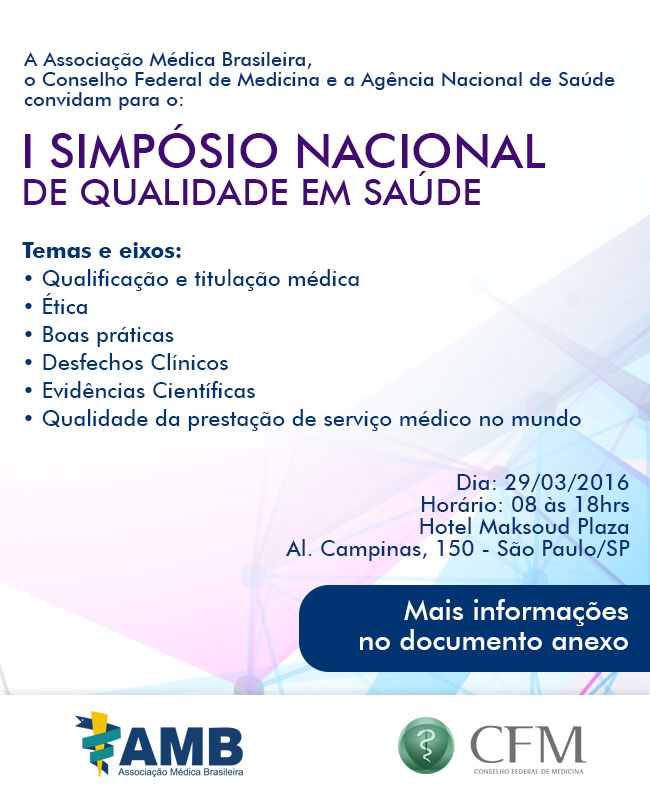
O chamado Fator de Qualidade, previsto na Resolução Normativa 364/14 da Agência Nacional de Saúde Suplementar (ANS), será tema de um simpósio promovido pelo Conselho Federal de Medicina (CFM) e a Associação Médica Brasileira (AMB), na próxima terça-feira (29 de março) em São Paulo (SP).
O I Simpósio Nacional de Qualidade em Saúde reunirá diversos segmentos – como ANS, AMB, CFM e conselhos regionais de medicina, ministérios da Educação e Saúde, sociedades de especialidades, Comissão Nacional de Incorporação de Tecnologias no SUS (Conitec), associações de defesa do consumidor e de planos de saúde, e institutos acadêmicos e de estudos – para estudar e debater os eixos temáticos: qualificação e titulação médica, ética, boas práticas, desfechos clínicos, evidências científicas e qualidade da prestação de serviço médico no mundo.
A abertura acontece às 9h, no Maksoud Plaza Hotel (SP), e abordará o tema Qualidade e Ética. O coordenador desta primeira mesa será o presidente do CFM, Carlos Vital. No simpósio, estão previstas mais duas mesas, sobre “Qualidade e Qualificação” e sobre “Qualidade e Ferramentas de Avaliação”, além da conferência “Como Adotar a Qualidade de Forma Eficaz em nosso Sistema de Saúde?”.


http://portal.cfm.org.br/images/stories/Noticias2016/isimposio-qualidade.jpg

Confira abaixo a programação:

I Simpósio Nacional de Qualidade em Saúde
Data: 29/03/2016 (terça feira)
Horário: 08h às 18h
Número de participantes: 200
Local: Maksoud Plaza Hotel, Alameda Campinas, 150, Jardim Paulista, São Paulo (SP)
Organização e Realização:
Associação Médica Brasileira – AMB
Conselho Federal de Medicina – CFM

Abertura
Mesa I: 09:00 às 10:40
Tema: Qualidade e Ética
Coordenação: Carlos Vital – presidente do CFM
Debatedores:
Emilio Cesar Zilli – diretor de defesa profissional da AMB
Salomão Rodrigues Filho – conselheiro federal CFM
- Ética e Bioética: Existem conflitos?
Sérgio Ibiapina – CFM
- Modelos de Remuneração: Qual o melhor?
Martha Oliveira – ANS
- A Qualificação na Incorporação da Tecnologia (ROL): Como fazer?
Raquel Lisbôa – ANS
- Como o paciente entende Qualidade: É possível?
Maria Inês Dolci – Associação Brasileira de Defesa do Consumidor (Proteste)
Debates com a plateia

Mesa II: 11:00 às 12:40
Tema: Qualidade e Qualificação
Coordenação: Florentino de Araujo Cardoso Filho – presidente AMB
Debatedores:
Luiz Aramicy Bezerra Pinto – presidente Federação Brasileira de Hospitais (FBH)
Ana Maria Malik – FGV-SP
- Qualidade Profissional é igual à qualificação? Qual o melhor?
José Cechin – Federação Nacional de Saúde Suplementar (FenaSaúde)
- Como a AMB pode influir na qualificação profissional? Estado da Arte
José Luiz Bonamigo Filho – AMB
- Como avaliar os médicos recém-formados? Prova para todos?
Paulo Chapchap – Hospital Sírio-Libanês
- As atuais faculdades de medicina com seus currículos atendem a qualidade?
Eloisa Silva Dutra de Oliveira Bonfá – Universidade de São Paulo (USP)
Debates com a plateia

Subtemas: Evidências Científicas e as Sociedades de Especialidades Médicas; qualificação profissional, avaliação de desempenho de egressos de medicina

Intervalo

Mesa III: 14:00 às 15:40
Tema: Qualidade e Ferramentas de Avaliação
Coordenação: José Carlos de Souza Abrahão – presidente ANS
Debatedores:
Eudes de Freitas Aquino – presidente Unimed do Brasil
Maurício Lopes – SulAmérica
- Experiência da Joint Commission em avaliação: Podem os parâmetros de hospitais serem adotados por serviços e consultórios?
Claudio Lottenberg – presidente Sociedade Beneficente Israelita Brasileira Albert Einstein (SBIBAE)
- A Sociedade de Especialidade e a avaliação da Qualidade: Vai melhorar o atendimento?
Eduardo da Silva Vaz – presidente Sociedade Brasileira de Pediatria (SBP)
- Os Hospitais “de ponta” e a acreditação? O que mudou na prática?
Carlos Figueiredo – Associação Nacional de Hospitais Privados (ANAHP)
- Como adequar qualidade e remuneração? Isto é utópico no Brasil?
Martha Oliveira – ANS
Debates com a plateia
 
Coffee Break

Conferência (16:00 às 16:40)
Como Adotar a Qualidade de Forma Eficaz em Nosso Sistema de Saúde? Será possível Unificar a Saúde Pública e a Suplementar?
Presidente da conferência: Cleiton de Castro Marques / Sindicato da Indústria de Produtos Farmacêuticos no Estado de São Paulo (Sindusfarma)
Álvaro Escrivão Junior / Fundação Getulio Vargas
Considerações finais com a plateia (16:40 às 17:00)
Emilio Cesar Zilli (AMB), Florentino de Araujo Cardoso Filho (AMB), Carlos Vital (CFM), Miyuki Goto (Fundação Getulio Vargas), Martha Oliveira (ANS), Salomão Rodrigues (CFM)