Mostrando postagens com marcador large classes. Mostrar todas as postagens

sexta-feira, 21 de outubro de 2016

Large classes


Decrease Class Size, Increase Learning

Regardless of the genetic makeup of any given class, too many students is a recipe for disaster and yet many districts keep student caps excessively high and wonder why student achievement isn't improving.

It is physically impossible for one teacher to meet with 34 students in a high school classroom individually every day, if we want that time to be meaningfully spent. Every child deserves to feel like the teacher is available to help with particular needs and struggles, but if the teacher slows down enough to address any one child, there is a chance many others will lose out.

How can we solve this never ending problem?

It's simple, reduce the class sizes or put more teachers in classes that must remain larger.

Setting up routines and rituals that allow students to take ownership of their learning takes time and if we want to do it so it works, and lessens the burden on the teacher, then we need to at least teach students these expectations across school settings in smaller classes like advisory and there must be a level of consistency kept.

Large classes can often be unwieldy to even the most successful and accomplished teachers and rather than spending time watching students flourish, teachers spend time managing behavior. 

We can all agree, that this is not what school should look like, yet in many places this is what happens. 

All or many of the following challenges can occur when there are too many kids in one room:
  • increased probability of distraction or distractable behavior
  • less time spent on instruction
  • group work can be impeded 
  • students don't get the close attention and feedback they require to succeed
  • higher likelihood of incidents that can escalate
  • less freedom to let students lead the lessons because there isn't much space to move around
  • creativity can be stifled because the pace can be stop and go
  • attendance can also be an issue in larger classes which also leads to other challenges
  • loss of personal touch 
  • difficulty building rapport and relationships with all students

In addition to the impact of having too many kids in a classroom, the additional workload for teachers outside of school assessing work and differentiating lessons appropriately can lead to accelerated teacher burn out. Let's face it working with more kids at once is more exhausting. We expend more energy to try to get them where they need to be.

If class sizes aren't going to be addressed because of bottom lines, either because of a lack of teacher resources or school funding, then we are going to have to find a way to function better inside of these undesirable situations.

terça-feira, 26 de abril de 2016

Large classes


Four Key Questions About Large Classes


http://www.facultyfocus.com/wp-content/uploads/images/iStock_lecture-hall_Medium-150902.jpg
Here's a set of questions about large classes that I'm thinking we ought to be discussing more than we are.

1. How many students make it a large class? Teachers who do and don’t teach large classes have their opinions, but it’s not clear who has the right answer. Often faculty views seem related to the size of their college or university. I once consulted at a small liberal arts college where I was asked to sign a petition against classes enrolling more than 35 students. At about the same time, I saw a list of the 10 courses most often taken by beginning students at my R1 university. Only two—English composition and physical education—enrolled fewer than 30 students, and most had many more.

More important than faculty opinions are their perceptions. If you think it’s a large class, chances are good you’ll teach it that way. I’ve observed classes with 35 students being taught as if the enrollment were closer to 350, and I’ve seen very large classes that looked and felt like they were being taught to 30 students.


2. Who should be taking large classes? We know who typically takes them—students in their first two years of college. The largest classes at most institutions are introductory-level survey courses that fulfill general education requirements, gateway courses to majors, or first courses in a degree program. In those classes, beginning students often don’t know many or any of their classmates. These are the courses where the most lecturing occurs and where it’s very difficult for faculty to establish relationships with their students. How well do these courses meet the learning needs of beginning students? Do we ever we consider the possibility of offering a large class to more experienced students who might be better equipped to cope with these learning environments?

3. What content is best suited for delivery in a big class? Of course, that’s a question best answered by those who know the content. But I’m not sure it’s a question we ever discuss. Is it foundational material, those disciplinary building blocks? Is it material that students can master on their own without much teacher involvement? Is it content that’s not really up for discussion? Is there more of the kind of content that works in large classes in some fields than others?

4. Who should be teaching the large classes? At many institutions, these introductory or first major courses are traditionally considered less desirable teaching assignments. They are often handed over to the new or beginning faculty who then work their way up to teaching more highly prized courses, including those in their areas of specialty.

Large classes are more difficult to teach than small ones, especially if you’re committed to active learning, classroom interaction, assignments that develop skills like writing, and testing practices that promote thinking more than memorization. They’re also more difficult because the classroom management issues grow right along with class size. So, if these courses are more difficult to teach, should they be assigned to those new to teaching and/or to the institution?

Are they good places for adjunct, continuing contract faculty, or for teachers hired for the express purpose of teaching them? Some think large classes are the perfect venue for charismatic teachers, those who’ve mastered (and often relish) the performance aspects of teaching. These are teachers who keep students attentive, but how well do these dramatic styles promote deep learning and intellectual skill development?

I’m pretty solidly against big classes and the kinds of learning experiences they typically provide, but I’m also a realist, so this post is raising questions about the best ways to deal with them. Do we examine our use of large classes as critically and creatively as we should? A lot of what we do in higher education, we do because that’s what everyone else is doing. I think large classes are a case in point. They’re a fact of life in higher education, and their existence is not something most of us are in a position to change, but many decisions about how they’re taught are under our control. What we decide isn’t trivial. It impacts the learning experiences of large numbers of students.

sexta-feira, 4 de dezembro de 2015

Large audiences


How to be a brilliant conference chair 

When you’re in the hot seat, don’t yawn or shoehorn in your own research. And for goodness sake, get speakers’ names right


‘However awkward it is, you must keep people to time,’ say our experts.    Photograph: Alamy 


Think of the worst conference chairs you have ever experienced. The ones who forgot or mispronounced the speakers’ names, or failed to turn up altogether.

The ones who didn’t notice the shy hand-raisers, and only called on the masters of gesticulation. Or the ones who took advantage of the opportunity to tell the audience about their fascinating research and superior knowledge. Or the ones who apparently couldn’t tell the time, didn’t seem to care that the audience was gasping for a drink, or let awkward silences drag on and on.
The self-aware among us will know in our heart of hearts that we have been one of these at one conference or another (possibly after a late night at the conference dinner). Although such debacles can be something of a scholarly rite of passage, there are ways to avoid these pitfalls – here is our (hard-earned) six-point checklist to help you become everyone’s favourite conference chair.

Be organised

Contact your speakers in advance, either at the conference or via email, to check if they’re happy for you to use their biography and title from the conference programme (people quite often change the focus of their paper by the time they come to present). 

Then, find your speakers at the coffee before the session so you can introduce yourself, find out how they prefer to be addressed and check how to pronounce their names (writing them down phonetically if necessary). In order to ensure seamless transitions, make sure that presentations are preloaded, and check that your speakers know how to find and open theirs. And know how to contact IT support in case the tech gods let you down.

Be inclusive

Do not give one speaker more prominence than the others, whoever they might be; highlight each person’s key publications and achievements equally. 

Be prepared for a stony silence when you open up the floor – prepare your own question for each speaker. But if there is a flurry of hands, don’t hog the time. Prevent questioners from dominating, bullying, or patronising speakers by courteously reminding them to come to the point.
Scan the audience to ensure that early career researchers and more reticent colleagues have an opportunity to address the panel. Try to make sure that all speakers get at least one comment or question.

Be selfless

Keep anecdotes about your own research to coffee time and let the speakers take the spotlight. If you find links with your own work, or think of references that might help to inform speakers’ research, talk to them or email them later. 

Encourage early career researchers and new speakers, and boost their confidence by thanking them for their presentation and showing an interest in their work. 

Be attentive

You are the chair, in full view of the room, so listen attentively and take notes on relevant points that could be used for questions later. Don’t fidget, or yawn. 

When it’s time for questions, stand to the side of the podium and scan the audience, leaving centre stage for your speakers. If multiple audience members raise their hands, make eye contact with each and nod discreetly so they know you have seen them.

Be firm

Always begin promptly and make sure you time each speaker’s individual slot, so that each has his or her fair share of the session. However awkward it is, you must keep people to time. Be prepared to tackle a speaker even if they are higher up the academic ranks, self-important, or simply stubborn enough to ignore you. 

Agree in advance with your speakers about what sign you will use to alert them that they need to begin drawing their talk to a close, such as a finger gesture (not that one). If necessary, know when to stop believing the speaker’s promises that they are about to conclude and inform them firmly that you will have to stop them there in order to introduce the next presenter.

Be positive

When you get to question time, it is your responsibility to lead the discussion by encouraging a dialogue between the audience and speakers. This can be the most rewarding part of the session; otherwise the experts may as well have stayed at home and read their paper to the cat. 

Ensure that everyone who wants to speak has the opportunity to do so, and try to read faces and feel the silences. This way you know when the questions have dried up and it’s time to thank the speakers and the audience, and say how great the session has been. When the time for the panel to end arrives, tie things up (even if there are more questions), allowing everyone to happily head for tea and biscuits or to the pub – where they won’t talk about you, because you did your job so well.


Joanne Begiato is a professor of history at Oxford Brookes University; Lorna Campbell is digital education manager at Edina at the University of Edinburgh; Steven Gray is lecturer in the history of the Royal Navy at the University of Portsmouth; Isaac Land is an associate professor at Indiana State University

quarta-feira, 13 de maio de 2015

Lectures


Getting the Most out of Guest Experts Who Speak to Your Class

By Randy Laist, PhD


Inviting guest speakers into your classroom is a classic teaching strategy. Welcoming other voices into the classroom provides students with access to other perspectives, adds variety to the classroom routine, and demonstrates that learning is a collaborative enterprise. At the same time, however, presentations by guest experts are often plagued by a variety of design flaws that hinder their educational effectiveness. Guest experts, being unfamiliar with the mastery level of the students in the class, may speak over the heads of the students, or they may present their material at a level that is inappropriately introductory. Because they are generally unfamiliar with the class curriculum, they may repeat information that the students have already learned, or their comments may not connect in any clear way with what the students already know and what they are currently learning. 


Miscommunication between the guest expert and the host professor, furthermore, may result in the guest’s presentation running either too short or, more commonly, too long. Despite these hurdles, the increasingly collaborative and interdisciplinary nature of higher education makes the kind of partnerships represented by guest-expert arrangements more important than ever. With a little extra preparation, professors can increase the likelihood of a productive guest expert experience.

Typically, professors may invest weeks of effort into scheduling a guest speaker, but less effort into arranging their classroom activities so that the speaker’s appearance will further the curricular objectives of the course. When professors invite guest experts into their classrooms, they tend to conceptualize the arrangement as a compartmentalized event that stands outside of the regular current of class activity. The block of time scheduled for the guest tends to represent a break from the class schedule, rather than an essential part of the course material. As a result, the guest’s contributions are not as impactful as they might be if steps were taken to ensure that some degree of alignment were achieved between the curriculum and the speaker. The following strategies may help professors optimize the value of guest experts whom they invite to address their students.

Communicate clearly with the guest about what the objectives of the class are, where the students are in the overall curriculum, and how the guest’s appearance in your class intersects with what the students are learning about that week. Encourage the guest expert to tailor her remarks toward specific learning goals that the students are actively pursuing. You might also consider providing your guest expert with a copy of your syllabus, as well as with a brief summary of presentations given by other guest experts who have addressed your class. 


Establish expectations about the length of time that the guest expert will speak. Do not ask a guest to stay for the entire class period. Experts should limit the lecture phase of their presentation to 30 minutes or less. Ideally, there should be time both before the guest’s presentation for the students to prepare to meet the guest, and then afterward for the students to discuss their observations and responses. 


Use the time before and after the guest’s appearance to establish connections between the guest’s area of expertise and the learning objectives of the class. Give students a specific task that encourages them to take notes while the guest expert talks (for example, compile a list of the three most interesting things the guest said). Have students research the guest expert’s background or area of expertise and prepare questions to ask of the speaker, particularly questions that relate the course content to the guest’s area of expertise. Always allow time for a class discussion in which the teacher and the students can develop ways of connecting what the guest has said to key concepts of the class. 


Encourage guest experts to teach, rather than simply to speak. Instead of asking them to simply talk about their area of expertise, ask them to speak with the students about what the students are learning. Guest lecturers ordinarily want to prepare comments, but their contributions to your class might actually more meaningful if they come simply expecting to respond to questions from the student and teacher. In addition to making the guest expert’s time in your class interactive and engaging, a more student-centered approach to the expert’s presentation will ensure that the guest expert is speaking directly to the concerns of the class. 


With the guest’s permission, videotape the presentation and make the recording available to the class. Compile electronic copies of any handouts, or ask for a copy of the guest’s PowerPoint presentation. Keeping a record of the guest’s appearance will make it possible for the class to continue to refer to the expert’s comments throughout the term, and it will allow future classes to benefit from the guest expert’s contribution as well. 


Professors who invite guest experts into their classrooms promote opportunities for creative new syntheses in an academic landscape too often characterized by disciplinary and professional silos. The simple guidelines outlined above can help professors engaged in this kind of work to ensure that their students are benefiting from these efforts.

Randy Laist, associate professor and curriculum director, Goodwin College


quarta-feira, 1 de abril de 2015

Lectures


Are lectures the best way to teach students?

University lectures are often slated for being boring and poorly attended, but is scrapping them a good idea? Academics debate the matter

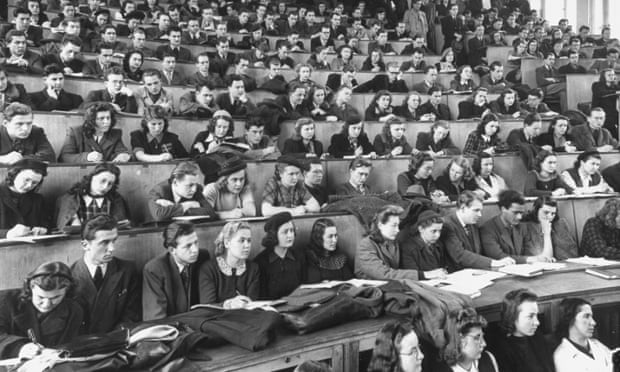
Is it time we moved on from lectures?
Is it time we moved on from lectures? 
Photograph: Alfred Eisenstaedt/Time & Life Pictures/Getty Image


‘It is sad that so few modern students will ever experience a real lecture’

Bruce Charlton, reader in evolutionary psychiatry, Newcastle University, says:

Real lectures are always greatly appreciated by students who want to learn. But what are called “lectures” nowadays are a travesty. 

Vast, stuffy venues that seat hundreds; students sitting in the dark and unable to see the speaker; a disembodied voice droning into a microphone; the lecturer reading out endless powerpoint slides which have already been posted online; the scanty audience passive instead of actively making their own notes – distracted by themselves and others intermittently browsing the internet and social networks; and the whole thing being recorded as if to emphasise to students that they don’t really need to be there nor pay attention.
These atrocities are what people currently call lectures, and they are indefensible.

But the alternatives to lectures are mere gimmicks and novelties designed to get praise and awards for teaching “innovation”. (A bicycle with triangular wheels is an innovation – the proper question is whether it is fit for purpose.) 

When lectures are taken seriously, and conducted in the proper way, they are the best pragmatic way of teaching knowledge to people who want to know.
Good lectures are possible and achievable – I experienced many of them at my medical school. But they are not easy, nor are they as cheap as some alternatives. Good lectures require all-round effort from people who appoint teaching staff and design lecture theatres; from those who construct courses and those who create the educational ethos.

And (hardest of all) good lectures require here-and-now concentration during the actual teaching period – effort from both lecturer and audience alike. A good lecture is hard work because it’s a one-off performance. Like the theatre rather than the cinema, everybody present contributes to the success or failure, everybody is involved. But when it works, it’s an experience that may be remembered forever.

Real lecturing is irreplaceable in the same way that live theatre or musical performance is irreplaceable – seeing and hearing each other in real-time and working together on something they both value.

It is sad that so few modern students will ever experience anything of this kind.

Empty lecture
‘We were faced with stubborn attendance problems on our large first-year modules. Classes often ended the semester half-empty.’ Photograph: Rex Features


‘There are a myriad of reasons – lapses in concentration or early starts, for example – why students don’t get as much out of lectures’

University teacher Sam Marsh, and senior lecturer Nick Gurski, in the school of mathematics and statistics at the University of Sheffield, say:
Well-delivered lectures can be a good way of passing on knowledge and they dominate teaching in higher education. But there are a myriad of reasons, lapses in concentration or early starts, for example, why students might not get as much from them as we’d hope – and these issues are amplified by large cohorts. 

We were faced with stubborn attendance problems on our large first-year modules. Classes often ended the semester half-empty. We’d tried our most popular lecturers, updated the course materials and introduced online tests with little effect. 

We decided to create a collection of specially-filmed short videos to replace lectures on a module teaching mathematics to engineers. 

Students would watch the videos online in their own time and each would be followed by a short quiz. By changing the character of weekly problem classes to include more demonstration and peer discussion we could double their frequency without a big increase in staff time. This would be where students would really benefit from interaction with both lecturers and other students.

When the pilot launched we quickly noticed that not only did students watch the vast majority of the videos on time, but attendance improved dramatically. Over the year students attended three times as many problem classes as traditionally-taught peers from other departments. 


When we applied statistical analysis to three years’ worth of exam data, comparing with other cohorts on the same syllabus, we found that we had added somewhere between 4 and 12 marks to the average grade of a student.

Our format is now expanding across the engineering faculty, and next year we will teach 1,000 students in this way.

There may, of course, be a limit to how many videos students can watch in a week. In some cases the time-honoured lecture format is working very nicely. But it seems clear to us that there are lots ways to teach, and some of the best don’t involve lectures.