Mostrando postagens com marcador recruitment and retention. Mostrar todas as postagens

sábado, 19 de janeiro de 2019

Med Schools recruitment


This doctor thinks medical schools should recruit more like Google and other tech companies


  • Jefferson Health's Stephen Klasko says medical schools are designed to "suck the creativity" out of their students.
  • Medical schools need to change their recruitment process and take a page from Google and other tech companies, he says.
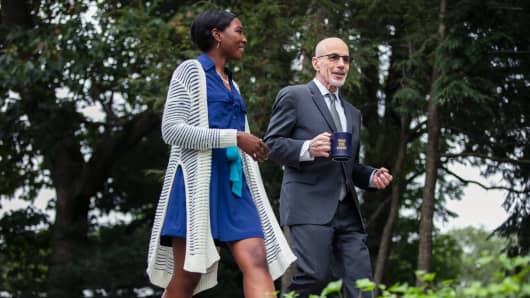


Jefferson Health's Steve Klasko walking through campus.
Jefferson Health
Jefferson Health's Steve Klasko walking through campus.


Dr. Stephen Klasko, the president of Thomas Jefferson University in Philadelphia and CEO of Jefferson Health, says that medical schools have the recruiting process all wrong.

In an age of advanced technology, they're still choosing students who can reel off organic chemistry compounds, rather than screening for qualities like critical thinking, entrepreneurship and empathy. Once students arrive, they're being asked to spend years on rote memorization.

It's a system designed to "suck the creativity out of physicians," Klasko said, while encouraging them to compete with each other, rather than collaborate.

Klasko is pushing Thomas Jefferson along a different path, one that's similarly being followed by Mount Sinai, Yale and Stanford. They're all seeking ways to find candidates that may not be obvious targets for medical school by using techniques that are well known to tech companies. Klasko's son once interviewed for a job at Google, and "they didn't want to see a transcript," he said. Recruiters asked him a series of questions to see whether he could come up with creative solutions on the fly.

Klasko has worked with a firm called Teleos Leaders, which has clients ranging from Cisco to IBM, to develop a program to select medical students on the basis of their emotional intelligence.

"We need to make medical students more human," Klasko said in an interview. "The way things are today is that you can be the most antisocial person in the room, but if we train you to pass a multiple choice test you can go and treat sick patients."

Jefferson is tapping humanities departments, design universities and drama schools to convince young graduates to consider a career in medicine. It has a partnership with Princeton University that allows about a dozen Princeton undergraduates each year to take the minimum number of science courses and study any other subjects they wish before attending medical school at Jefferson.

It also has a program that trains students in design thinking under Bon Ku, an emergency room physician who was described by a local publication as "one of the coolest docs in Philadelphia." Ku graduated with a degree in classics and was terrible at math.

FlexMed at New York's Mount Sinai allows college sophomores in any major to apply for early acceptance. Students in humanities have proven to be just as successful as those with a science background, and they're more likely to choose primary care or psychiatry as a specialty, which are both areas facing shortages. Other med schools like Yale and Stanford are offering art appreciation courses alongside traditional subjects like pathology and microbiology.


The role of AI in medicine

Ku predicts that as artificial intelligence become more prominent, memorization skills will become far less relevant.

"We still need the basic memorization of scientific knowledge, but no human can possibly keep up," Ku told CNBC. "Medical knowledge is doubling at this crazy rate. So instead there should be a greater emphasis on creative problem solving."

Klasko sees a future in which technology will be used to provide an immediate list of drugs for a particular case and offer clinical decision support tools to make a diagnosis. That will free doctors up to spend time listening to their patients, improving their surgical techniques or learning new skills.

Klasko has a real-life example. He said that in his career as an obstetrician and gynecologist, he's delivered thousands of babies. While most are fairly routine, occasionally an infant is born unexpectedly with a genetic disease like Down Syndrome. In such cases, parents will often ask him what it all means.

They don't want a detailed explanation of the chromosomal anomaly, but rather to understand how to deal with this new reality and how to be proper caregivers. Sometimes they just to talk to someone about their hopes and fears.

"At some point, the real bar should be whether or not you can actually listen to patients and talk to them," Klasko said.

quinta-feira, 16 de abril de 2015

Remote area Health


Medical student selection criteria and socio-demographic factors as predictors of ultimately working rurally after graduation

Ian B Puddey*, Annette Mercer, Denese E Playford and Geoffrey J Riley
 
*Corresponding author: Ian B Puddey
 
BMC Medical Education 2015, 15:74
doi:10.1186/s12909-015-0359-5
Published: 14 April 2015 
 

Abstract (provisional)

Background We have previously demonstrated that both coming from a rural background and spending a year-long clinical rotation in our Rural Clinical School (RCS) have independent and additive effects to increase the likelihood of medical students practicing rurally following graduation. The current study assesses the extent to which medical school selection criteria and/or the socio-demographic profile of medical students may further facilitate or hamper the selection of students ultimately destined for the rural medical workforce. Methods The study comprised 729 students, admitted from secondary school since 1999 and having graduated by 2011, whose actual workplace location in 2014 was classified as either urban or rural using the Australian Health Practitioner Regulation Agency database. Selection factors on entry (score from a standardised interview, percentile scores for the 3 components of the Undergraduate Medicine and Health Sciences Admission Test (UMAT) and prior academic performance as assessed by the Australian Tertiary Admissions Rank) together with socio-demographic factors (age, gender, decile for the Index of Relative Socioeconomic Advantage and Disadvantage (IRSAD)), were examined in relation to ultimate rural destination of practice. Results In logistic regression, those practicing in a rural location in 2014 were more likely to have come from the lower 6 IRSAD deciles (OR 2.75, 95% CI 1.44, 5.23, P = 0.002), to be older (OR 1.86, 95% CI 1.09, 3.18, p = 0.023) and to have a lower UMAT-3 (Non-verbal communication) score (OR 0.98, 95% CI 0.97, 0.99, P = 0.005). After further controlling for either rural background or RCS participation, only age and UMAT-3 remained as independent predictors of current rural practice. Conclusions In terms of the socio-demographic profiles of those selected for medical school entry from secondary school, only older age weakly augmented the selection of graduates likely to ultimately work in a rural destination. Among the selection factors, having achieved higher scores in UMAT-3 tended to mitigate this outcome. The major focus in attempts to grow the rural medical workforce should therefore remain on recruiting medical students from a rural background together with providing maximal opportunity for prolonged immersion in rural clinical environments during their training. 

The complete article is available as a provisional PDF.


sábado, 27 de julho de 2013

Medicina em Áreas Remotas


'Any body is better than nobody?' Ethical questions around recruiting and/or retaining health professionals in rural areas


Author(s) : Simpson C, McDonald F.


Christy Simpson


Fiona McDonald
Rural and Remote Health 11: 1867. (Online) 2011.


Abstract

INTRODUCTION:

The literature on recruiting and/or retaining health professionals in rural areas focuses primarily on the development of recruitment and retention strategies and assessing whether such strategies are effective. The objective of this article is to argue that it is important for all stakeholders involved in rural recruitment and/or retention processes to consider their decisions and actions from an ethics perspective. Recruitment and/or retention processes are not value neutral and it is important to understand their ethical dimensions.

METHODS:

From the literature, elements of the recruitment and/or retention strategies that have been employed were identified and organised in respect of levels of governance (namely, the levels of health system/government, community, and individual health professionals). The elements identified in these levels were subjected to analysis to identify their ethical dimensions and to determine whether a clash or complement of values arose at each level of governance or between governance levels.

RESULTS:

There is very little literature in this area that considers the ethical dimensions of rural recruitment and/or retention processes. However, all policies and practices have ethical dimensions that need to be identified and understood as they may have significant implications for recruitment and/or retention processes.

CONCLUSIONS:

This article recommends the application of an ethics perspective when reflecting on rural recruitment and/or retention strategies. The collective decisions of all involved in rural recruitment and/or retention processes may fundamentally influence the 'health' (broadly understood) of rural communities.
 --------------------------------------------------------------------------------
Key words: ethics, recruitment and retention, rural health, rural service, workforce. 


For full text article, click here.