Mostrando postagens com marcador Social networks. Mostrar todas as postagens

segunda-feira, 27 de junho de 2016

Networking


Networking for Introverts - 7 Simple Steps

Michael S Solomon  


You’ve heard it before: it’s not what you know, but whom you know. But...you hate networking. That’s ok, a lot of people do. And networking for introverts is even more challenging. According to Susan Cain’s, The Power of Introverts Ted Talk over 50 percent of the U.S. workforce self-identifies as introverts. The good news is that you’re not alone and you can learn how to network in 7 simple steps, no matter how introverted you are. 
Step 1: Find Meetups and Other Networking Events

Before you go wow people with your cocktail party conversation (or lack thereof), you need to have places to go. Most major cities in the US have tech meetups and other networking events. Finding the right ones can seem like a pain, but you’d be surprised what a little Google searching for “Best Tech Meetups in [CITY]” will bring up. 

Most local accelerators and incubators will have pitch sessions, demo days and the like. Here, let me google that for you.

Step 2: Have a Standard Opener

Ok, you’ve made it to the 500 Startups Demo Day (or wherever) and you’re standing there alone thinking...what should I say? Seriously, just remember everyone is there for the same reason: to meet people. Through my work I’ve learned something very important about people. We’re all insecure; some people are just better at hiding it.

So, what should you say? Dale Carnegie the author of “Making Friends and Influencing People” always said that the best way to meet people is to get them talking about their favorite subject: themselves.

That’s right. There’s really no better opener than, “So, what brings you here?”

Want a bonus follow-up that will engender you to them as a “great person” forever. Just say, “Sounds really interesting. What are you looking for today? Perhaps I can help.” Of course, if it doesn’t sound really interesting, you can omit that or try another response to what they said. The last thing our world or you need is more insincerity.

Step 3: Develop your elevator pitch

No matter how many witty jokes and questions you memorize, at some point you’re going to have to talk about yourself. This may seem obvious, but it’s amazing how many people don’t think about how they are going to talk about themselves until someone asks them, and then it’s either 20 seconds of awkward silence or 20 minutes of mindless yammering. 

Here’s a tip: Have a 30 second intro for yourself that you’ve already thought about and perhaps practiced saying out loud. To learn how to create your own elevator pitch check out this article or watch this YouTube playlist on elevator pitch instructions. After your pitch, then pivot back to a question about them. That’s right: Talk about yourself for 30 seconds and then ask them a question, have some well thought-out talking points ready in your head. That’s how you get a conversation going and how you avoid that panicky frozen feeling in your gut.

Step 4: Choose your people

Before the event find a list of attendees and do some online research about them, pick the ones you want to know. If you feel comfortable with it, connect online prior to the event and arrange a quick one-on-one session during a break at the event. This often allows you to have a more substantive conversation since you will know a bit about each other from the start. 

Step 5: Pace yourself and be strategic

Before the event set a realistic quota of how many contacts you’d like to meet. For your first couple of events start out with a small number so you can feel proud of yourself and build on that number. Are you a morning person or more alert in the evening? Schedule your meetups based on the time of day when you’re at your best. Ensure that you allow time to recharge, whether by taking a short walk, a restroom break or checking out the venue. Resist the urge to try and be in constant ‘On’ mode.

Step 6: Collect Business Cards and Write on Them

This may seem very 1995, but business cards are still extremely useful for one thing: collecting and writing details of the conversation on. And it seems more polite than taking notes on your phone.
 

Did someone tell you he’s looking for a Node.js developer and you know one? Write it down on his card.

Step 7: Follow Up (a no brainer)

The worst thing you can do, but what MOST people do anyway, is go to a networking event, meet a ton of people, and never have any contact with them again. Why waste their time and yours? Depending on your goals, you can follow-up in many ways the day after the event:
  • Connect with them on LinkedIn, Facebook or other well known social platforms
  • Sit down with your stack of annotated cards and send everyone a unique email. “Hey [NAME], great meeting you yesterday at [EVENT]. [THEIR PROJECT] sounds really interesting. Let me know if I can be of any help! Best, [YOUR NAME]”

It really doesn’t need to be more than that. And it shouldn’t be more self-serving than that unless the conversation was squarely about you and your project, and this person was REALLY interested in helping you in someway.

That’s it!

Who knows networking might eventually become fun for you. Just remember instead of thinking about making small talk with strangers reframe that thought with - I get to connect with fellow humans across what once seemed like an impassable chasm. Stay curious about others and follow these 7 simple steps, you’ll be well on your way to networking like a champion.


segunda-feira, 28 de março de 2016

Social media for academics


Follow the leaders: the best social media accounts for academics

Irreverent, funny and informative – higher education does the internet really well. Here are our favourite blogs and Twitter accounts


Laptop
Your colleagues have taught difficult lectures, handled endless meetings and lived to tell the tale – on the internet. Photograph: Alamy


University life often involves being stuck at a desk; writing articles, marking and planning. Lucky, then, that this usually means there’s an internet connection nearby, offering an escape into the wide world of university-related advice and humour on the web. Here are some of our favourites (and we’d love to hear yours in the comments).

Twitter humour

Feeling despair at a looming deadline? Had a crappy piece of review feedback? You’re not alone. These Twitter accounts offer a constant stream of catharsis.
@ShitAcademicsSay Does what it says on the tin.
@Academic Pain Gifs to make you laugh on the outside (while crying on the inside).
@ShitMyReviewersSay Think you’ve had a bad review? You ain’t seen nothing yet.
@AcademiaObscura The lighter side of academic life, and home to the prestigious annual Academics with Cats competition.
@TheLitCritGuy A tongue-in-cheek take on literary theory. 

Tips on writing, teaching and academic life

Your colleagues have taught difficult lectures, handled endless meetings and lived to tell the tale. And they often tell those tales on the internet, meaning there’s a wealth of information and advice out there to help you in your career.
 The Virtual Leader A teaching expert offers up her hard-won knowledge, including lots of helpful tips on how to use internet-based learning tools. 
Tenure, She Wrote A collective of female academics (mostly based in the US) document the ups and downs of university life, with a feminist slant.  
ALawUntoHerself Reflections on teaching and research from a law PhD candidate and clinical supervisor. 
Cash for Questions: social science research funding, policy, and development Adam Golberg, a research manager at Nottingham University Business School, blogs about how to get funding. 
Janni Aragon’s blog A political scientist and senior lecturer at University of Victoria in Canada offers teaching tips and book reviews. 
The LSE Impact Blog A mix of personal and policy-related posts, useful for social scientists and those with an interest in the impact of research beyond academia. 
@RealScientists An insightful Twitter account – run by a different scientist each week – looking at new discoveries as well as the lives of the greats. 
@Research_Voice A bridge between researchers and policymakers in Europe, offering expert views, developments in research and jobs.

PhD 101

Studying for a PhD can be exciting and terrifying, often in equal measure. Thankfully there’s a wealth of advice out there for academics navigating the early stages of their careers. 
The Early Career Blog Steve Joy, a careers adviser for arts, humanities and social sciences researchers at the University of Cambridge, gives his tips for success. 
James Hayton PhD A former nervous PhD student, now a post-doc, shares his wisdom about how to write a thesis without losing your mind. 
Get a Life, PhD A popular blog with plenty of PhD advice and guest posts from those in the know. 
The Thesis Whisperer A comprehensive and long-running site that covers everything from dealing with supervisors to tackling your reading list.

NEWS AND VIEWS

There are some brilliant blogs out there offering updates on higher education (in addition to the Higher Education Network, of course). 
Athene Donald’s blog The physicist and champion of women in science writes on policy, research and gender. 
HE Watch Views of the sector written and curated by Steven Jones, a senior lecturer at the Manchester Institute of Education. 
Critical Education Journalist and higher education author Andrew McGettigan raises an eyebrow at government policy, with a particular focus on finance and student loans. 
Wonkhe Editor Mark Leach and his team publish thinkers from people across the sector, offering insights into policy and a wide variety of related issues. 
University Ranking Watch University rankings expert Richard Holmes analyses the methodology and usefulness of various league tables. 
Emma Sabzalieva’s blog A view of higher education from central Asia. 
Dr Education Trends and insights of international higher education from Rahul Choudaha, who previously worked at World Education Services in New York.

segunda-feira, 16 de novembro de 2015

Internet e desenvolvimento social


Prezados (as) Senhores (as):

Encontram-se abertas as inscrições do Fórum Permanente de Sociedade e Desenvolvimento - "Impactos da internet e das mídias móveis no desenvolvimento social, a ser realizado na data de 19 de novembro de 2015, no Auditório do Centro de convenções da UNICAMP.
http://www.foruns.unicamp.br/foruns/projetocotuca/forum/htmls_descricoes_eventos/soc_e_desenv13.html

Para efetuar a sua inscrição, cadastre-se no site dos Fóruns. Caso já possua cadastro, efetue login e inscreva-se em "programação de eventos 2015 e procure o fórum pelo título".


Atenciosamente,

Sônia Maria de Camargo Mazzariol
Assistente Técnica de Direção - Coordenadoria Geral da Universidade
Universidade Estadual de Campinas - SP - Brasil.

quinta-feira, 3 de abril de 2014

Social Networking


The Use of Social Networking Sites for Public Health Practice and Research: A Systematic Review

Daniel Capurro1,2, MD, PhD; Kate Cole2, MPH; Maria I Echavarría3, MPH; Jonathan Joe2, BS; Tina Neogi4, MD, MPH; Anne M Turner2,5, MD, MPH, MLIS
1Evidence Based Healthcare Program, Department of Internal Medicine, Escuela de Medicina, Pontificia Universidad Catolica de Chile, Santiago, Chile
2Department of Biomedical Informatics and Medical Education, School of Medicine, University of Washington, Seattle, WA, United States
3Department of Global Health, School of Medicine, University of Washington, Seattle, WA, United States
4Department of Family Medicine, School of Medicine, University of Washington, Seattle, WA, United States
5Department of Health Services, School of Public Health, University of Washington, Seattle, WA, United States
Corresponding Author:
Daniel Capurro, MD, PhD

Evidence Based Healthcare Program
Department of Internal Medicine, Escuela de Medicina
Pontificia Universidad Catolica de Chile
Lira 63
Santiago, 8330044
Chile
Phone: 56 223543030
Fax: 56 223543030
Email: dcapurro [at] med.puc.cl


ABSTRACT

Background: Social networking sites (SNSs) have the potential to increase the reach and efficiency of essential public health services, such as surveillance, research, and communication.
 
Objective: The objective of this study was to conduct a systematic literature review to identify the use of SNSs for public health research and practice and to identify existing knowledge gaps.
 
Methods: We performed a systematic literature review of articles related to public health and SNSs using PubMed, EMBASE, and CINAHL to search for peer-reviewed publications describing the use of SNSs for public health research and practice. We also conducted manual searches of relevant publications. Each publication was independently reviewed by 2 researchers for inclusion and extracted relevant study data.
 
Results: A total of 73 articles met our inclusion criteria. Most articles (n=50) were published in the final 2 years covered by our search. In all, 58 articles were in the domain of public health research and 15 were in public health practice. Only 1 study was conducted in a low-income country. Most articles (63/73, 86%) described observational studies involving users or usages of SNSs; only 5 studies involved randomized controlled trials. A large proportion (43/73, 59%) of the identified studies included populations considered hard to reach, such as young individuals, adolescents, and individuals at risk of sexually transmitted diseases or alcohol and substance abuse. Few articles (2/73, 3%) described using the multidirectional communication potential of SNSs to engage study populations.
 
Conclusions: The number of publications about public health uses for SNSs has been steadily increasing in the past 5 years. With few exceptions, the literature largely consists of observational studies describing users and usages of SNSs regarding topics of public health interest. More studies that fully exploit the communication tools embedded in SNSs and study their potential to produce significant effects in the overall population’s health are needed.
 
(J Med Internet Res 2014;16(3):e79)
doi:10.2196/jmir.2679

public health informatics; public health; social network; health communication

domingo, 1 de dezembro de 2013

Aprendizado em Rede


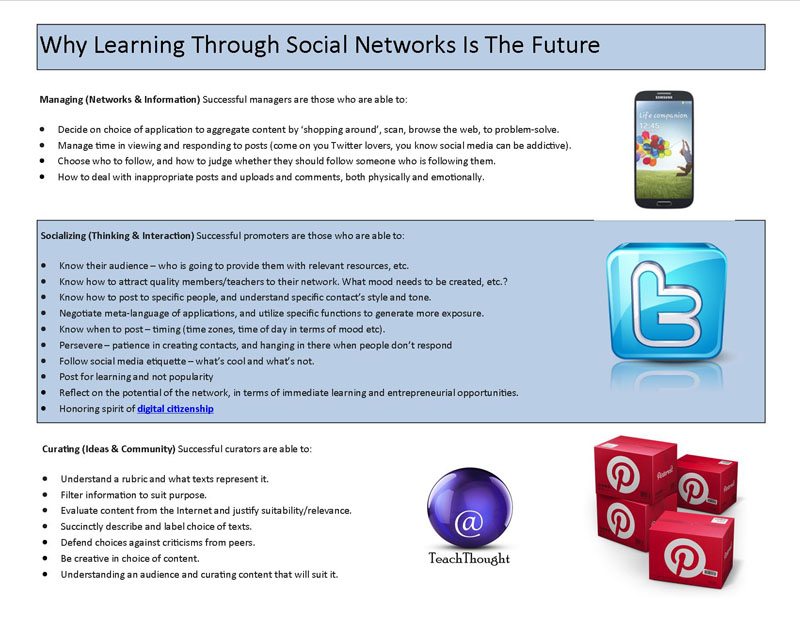
Why Learning Through Social Networks Is The Future

vancouverfilmschool-learningthroughnetworks 

Paul Moss, edmerger.com

Students Need Professional Learning Networks, Too

Learning to create, manage and promote a professional learning network (PLN) will soon become, if it’s not already, one of the most necessary and sought after skills for a global citizen, and as such, must become a prominent feature of any school curriculum.

Few progressive educationalists would argue that a personal learning network (PLN) is not incredibly valuable and important. Passionate advocates including Murray, Whitby, and Sheninger lead with clarity in such discussions. The wealth of professional development that stems from such a network is quickly defining it as an essential tool for teachers, and will, I believe, replace organised costly professional development undertaken by organisations.

However presently, few discussions and promotions of PLN’s venture further than lauding specific benefits for teachers. But why just teachers, and not students? Could students benefit from a network of learners? Considering the importance of exams in determining futures, it seems that professional development for students not only has unbounded potential, but must be taught as a matter of urgency.

Establishing a PLN seems simple enough on the surface, but to do it successfully and optimize its potential contains within in it a challenging and vigorous set of learning opportunities. Curating, managing, and promoting a PLN develops critical, creative, 21st century, and an increasingly important set of socio-emotional capabilities. Integration into modern curriculums would be seamless. Of course the best way to teach is to show, not tell, so here is a list, but by no means a definitive list, of the skills that are learned:

learning-through-networks-sized

1. Curating (Ideas & Community)

To curate or not to curate – that is actually not the question. The question is how good are you at it. In a world where information is amassing exponentially on the internet, becoming skillful at filtering and selecting appropriate information will become imperative, and much sooner than we think.

The trend is irrefutable (Rosenbaum), and can facilitate reaching political disruption as Twitter founder Evan Williams notes. Some education companies are emerging (Learni.st, Knodium) who understand the context, but exponents agree that successful curators are those who are able to:

  • Understand a rubric and what texts represent it.
  • Filter information to suit purpose.
  • Evaluate content from the Internet and justify suitability/relevance.
  • Succinctly describe and label choice of texts.
  • Defend choices against criticisms from peers.
  • Be creative in choice of content. Understanding an audience and curating content that will suit it, including considering context, use of humour, use of suitable language.

2. Managing (Networks & Information)

Successful managers are those who are able to:
  • Decide on choice of application to aggregate content by ‘shopping around’, scan, browse the web, and listen to peers etc. to ascertain the best solution.
  • Manage time in viewing and responding to posts (come on you Twitter lovers, you know social media can be addictive).
  • Choose who to follow, and how to judge whether they should follow someone who is following them.
  • How to deal with inappropriate posts and uploads and comments, both physically and emotionally.

3. Socializing (Thinking & Interaction) 

This develops a range of enterprise skills, beginning with knowledge of creating a theme or mood or personal brand. Successful promoters are those who are able to:

  • Know their audience – who is going to provide them with relevant resources, and who is going to connect them to others who have quality resources
  • Know how to attract quality members/teachers to their network. What mood needs to be created, and is it consistent over their posts and uploads?
  • Know the importance of posting good quality content.
  • Know how to post to specific people, and understand specific contact’s style and tone
  • Negotiate meta-language of applications, and utilize specific functions to generate more exposure, including using tags effectively.
  • Know when to post – timing (time zones, time of day in terms of mood etc).
  • Persevere – patience in creating contacts, and hanging in there when people don’t respond
  • Follow social media etiquette – what’s cool and what’s not.
  • Post for learning and not popularity
  • Reflect on the potential of the network, in terms of immediate learning and entrepreneurial opportunities.
  • Honoring spirit of digital citizenship

Learning Through Networks

The advantages of learning of such skills are clear, but there is one ultimate perk. The creation of an independent learner, a learner who can adapt to changing contexts by engaging their network, a learner who can confidently navigate through the jungle of the Internet. But let’s not make students wait while teachers themselves come to terms with the power of the PLN. Students already have a very solid prior knowledge of the power and functionality of networks. They enthusiastically engage with them everyday for social and entertainment purposes. The skilled teacher is the one who can take that prior knowledge and enthusiasm and teach students to leverage it to their learning advantage.

Networking is not just a trend, a fad that will die out soon enough. The success of Facebook, Twitter and LinkedIn is not simply a result of cool fashionable technology. Dawson suggests networking is actually very intuitive, and his analogy of it as an organic breathing entity is useful. Indeed, all nature is organised in such a fashion, from DNA and cell functionality to chemistry to successful social interaction. Many things benefit from not being in isolation.

Defoe’s Robinson Crusoe was a warning, not just a story. Let’s not let students leave school in isolation, with only Friday on their minds. Let’s ensure they are well connected, independent, and empowered to learn anywhere, anytime.


Paul Moss has a Masters Degree in Education specializing in integrating technology into the curriculum, and student motivation, and has spent 10 years teaching across the world in Australia, Spain, and the UK. Paul is a passionate advocate of student voice and increasing opportunities for independent learning, and is gaining reputation as a pedagogy watchdog. Paul is the CEO of EDmerger. Paul is the proud father of 3 daughters. Follow Paul on twitter @edmerger, and on Tumblr at paulgmoss.tumblr.comImage attribution flickr user vancouverfilmschool; Why Learning Through Social Networks Is The Future

segunda-feira, 28 de maio de 2012

Ética Médica


SOBRE A EXPOSIÇÃO DE PACIENTES NA MÍDIA: FOTOS, VÍDEOS, ETC.

Helvécio Neves Feitosa – CREMEC 3754
Coordenador da Comissão de Ética Médica do NAMI/UNIFOR


A Comissão de Divulgação de Assuntos Médicos (CODAME) do CREMEC vem tendo um trabalho de crescimento exponencial com relação à publicidade médica em desacordo com o que preconiza a Ética Médica, em particular a Resolução N° 1.974/2011 (que atualizou e revogou a Resolução N° 1.701/03), instrumento normativo que estabelece os critérios norteadores da propaganda em Medicina, conceituando os anúncios, a divulgação de assuntos médicos, o s ensacionalismo, a autopromoção e as proibições referentes à matéria, e o próprio Código de Ética Médica (CEM), no capítulo que disciplina a publicidade médica (Capítulo XIII, artigos 111 a 118) e em outros dispositivos do mesmo elenco de normas.

As infrações mais frequentes são fotos de pacientes postadas na Internet, vídeos de procedimentos em sites como o Youtube e congêneres, anúncios profissionais na mídia eletrônica, falada e escrita em desobediência aos ditames da Ética Médica, em geral de conteúdo autopromocional e sensacionalista. Os colegas que assim procedem têm sido frequentemente chamados ao Conselho para orientação e assinatura de TAC (Termo de Ajustamento de Conduta), numa abordagem inicial de caráter pedagógico. A persistência da irregularidade e/ou a gravidade do desvio cometido, têm ensejado à abertura de Sindicâncias, frequentemente seguidas da instalação de PEP (Processo Ético-Prof issional).

O Art. 3º da Resolução N° 1.974/2011 estabelece ser vedado ao médico: (...) g) Expor a figura de seu paciente como forma de divulgar técnica, método ou resultado de tratamento, ainda que com autorização expressa do mesmo, ressalvado o disposto no art. 10 desta resolução. O artigo 10 da dita Resolução estabelece que: Nos trabalhos e eventos científicos em que a exposição de figura de paciente for imprescindível, o médico deverá obter prévia autorização expressa do mesmo ou de seu representante legal.

O CEM estabelece, no Capítulo IX, que trata do Sigilo Profissional, ser vedado ao médicoArt. 75. Fazer referência a casos clínicos identificáveis, exibir pacientes ou seus retratos em anúncios profissionais ou na divulgação de assuntos médicos, em meios de comunicação em gera l, mesmo com autorização do paciente(grifo nosso).

Para médicos no exercício da docência, convém observar a vedação estabelecida no Art. 110: Praticar a Medicina, no exercício da docência, sem o consentimento do paciente ou de seu representante legal, sem zelar por sua dignidade e privacidade ou discriminando aqueles que negarem o consentimento solicitado(grifos nossos).

Há vários aspectos a serem considerados no Art. 110 do CEM. O primeiro deles é a validade do consentimento, nomeadamente ao se cotejar as condições de saúde, culturais e socioeconômicas de quem está consentindo. Aí entra a importância da compreensão do que seja o conceito de vulnerabilidade, que de acordo com a Resolução 196/96, do Conselho Nacional de Saúde (a qual estabelece as Diretrizes e Normas Reguladoras de Pesquisa Envolvendo Seres Humano), refere-se a estado de pessoas ou grupos, que por quaisquer razões ou motivos, tenham a sua capacidade de autodeterminação reduzida, sobretudo no que se refere ao consentimento livre e esclarecido. Portanto, previamente à obtenção do TCLE (Termo de Consentimento Livre e Esclarecido) devemos nos questionar: será que um paciente atendido no SUS, em situação de emergência (ou não), está preenchendo as condições de exercício da autonomia plena (ou autodeterminação), a tornar um TCLE eticamente válido?  O mesmo instrumento normativo orienta-nos sobre o conceito de incapacidade: Refere-se ao possível sujeito da pesquisa que não tenha capacidade civil para dar o seu consentimento livre e esclarecido, devendo ser assistido ou representado, de acordo com a legislaçã o brasileira vigente e nos alerta que: A eticidade da pesquisa implica em: a) consentimento livre e esclarecido dos indivíduos-alvo e a proteção a grupos vulneráveis e aos legalmente incapazes ( autonomia). Neste sentido, a pesquisa envolvendo seres humanos deverá sempre tratá-lo em sua dignidade, respeitá-lo em sua autonomia e defendê-lo em sua vulnerabilidade (...).

Outro aspecto relevante a ser considerado é o entendimento do conceito de dignidade, termo mais bem definido na esfera da Filosofia, como sendo um valor moral e espiritual inerente à pessoa, a todo ser humano, sendo que o princípio da dignidade da pessoa humana constitui-se num dos princípios máximos do Estado Democrático de Direito. De fato, a nossa atual Carta Magna, em seu Art. 1º, ao instituir que a República Federativa do Brasil se constitui em Estado Democrático de Direito, estabelece em seu inciso III a dignidade da pessoa hu mana como um dos seus fundamentos. 

Na esfera filosófica, a sua formulação clássica foi estabelecida por Immanuel Kant, na obra “Fundamentação da Metafísica dos Costumes”, ao defender que as pessoas deveriam ser tratadas como um fim em si mesmas, e não como um meio (objetos), o que se extrai da formulação do seguinte princípio: “No reino dos fins, tudo tem um preço ou uma dignidade. Quando uma coisa tem preço, pode ser substituída por uma equivalente; por outro lado, a coisa que se acha acima de todo preço, e por isso não admite qualquer equivalência, compreende uma dignidade”. Em suma, a dignidade da pessoa humana é a qualidade intrínseca e distintiva de cada ser humano que o faz merecedor do mesmo respeito e consideração por parte do Estado e da comunidade, simplesmente por pertencer à espécie Homo sapiens.

Expor imagens de pacientes (por meio de fotos, vídeos, etc.), com ou sem consentimento livre (???) e esclarecido é ferir a sua dignidade, com implicações éticas e legais. De fato, na vertente legal, a Constituição Federal estabelece em seu Art. 5º, inciso X: “são invioláveis a intimidade, a vida privada, a honra e a imagem das pessoas, assegurado o direito a indenização pelo dano material ou moral decorrente de sua violação;”(...).

A Comissão de Ética Médica do NAMI/UNIFOR tem como uma de suas atribuições, exercer função pedagógica no sentido de alertar os colegas com relação às implicações éticas e legais de exposição de pacientes no exercício da docência, em anúncios, redes sociais, publicações, eventos científicos e outros.

quarta-feira, 4 de abril de 2012

Mídias Sociais

Should Professors Use Facebook to Communicate with Students? One Opinion

Nearly 85% of faculty have a Facebook account, two-thirds are on LinkedIn, and 50% are on Twitter according to research from Faculty Focus. But, professors' use of social media shows we are behind the relationship curve when it comes to connecting with students. Only 32% have friended undergrad students and about half (55%) connect with some students after graduation.

Some faculty may be hesitant to friend students on Facebook. To do so on an isolated basis can send the wrong signals, and I know some faculty prefer to keep a clear line between the role of teacher and student. So, why might instructors want to connect with current students on Facebook?

First, it's where students are. With the help of the students in our upper level marketing courses, we recently surveyed over 500 students regarding their social media use. Over two-thirds (69.8%) are on Facebook every day. In case you're wondering, 63% also have Twitter accounts and half (49.8%) check them daily. As teachers, our job is to communicate with students. Sure, we can communicate with them in other ways. But, if you want to speak to your audience in the way they prefer and in the way they communicate with each other, you'll connect through social media. That's what I do and I learn a lot from my students that way as they often post industry-related articles on Twitter or Facebook to my attention.
Second, anyone who studies marketing knows that social influence is a primary factor in consumer decision making. If you want to influence others in any meaningful way, you must provide value within their social circles. Granted, the kind of value faculty may offer students via social media is questionable. Even if we think we are cool, odds are pretty high we are not. But, students don't expect us to be cool. They know we are their instructors, not their peers. That means their expectations are pretty low. That said, what makes a good friend is often just being there. If you're not there and not aware of what's going on in their lives, you will have a harder time relating to them.
Third, you can overcome sending the wrong signals to students by inviting all students in your classes to friend you on Facebook. They are smart enough to know they can do so and still screen who sees what on their posts. So, no need to worry that they will be afraid you'll get too close to them. By the same token, you can designate students into specific friends lists that you can choose when you want to post to them or not. If you don't know how, just ask a student.
I can see how instructors in large, survey courses with perhaps hundreds of students wouldn't want to follow this advice. I wouldn't either. But, most of us teaching in upper-level courses have students in a dedicated major with relatively high overlap with our interests. Faculty already on Facebook tend to post comments, articles, and highlights related to the discipline and that provides an instant connection with our students. This leads to the next reason to connect with students through social media.
Fourth, the number one best way I've found to keep track of our graduates is through our Facebook group page for our major. We can post job openings, graduate news (like congrats on new positions), and activities within the major all in one place. A huge plus is that current students can connect with grads from prior years in the Facebook group for networking purposes.
I'm sure you can still be an effective teacher without connecting with students on Facebook. I can also understand why some of my colleagues may not want to engage with students on social platforms. But, if you're looking for a way to communicate with them the way they communicate, learn something about what's going on in their lives, and to stay connected after they graduate, then inviting the class to join you on Facebook is a good start.


Kirk Wakefield, Edwin W. Streetman professor of retail marketing, Hankamer School of Business, Baylor University.
SOURCE: Feb 27, 2012  http://www.facultyfocus.com/articles/trends-in-higher-education/should-professors-use-facebook-to-communicate-with-students/?utm_source=cheetah&utm_medium=email&utm_campaign=2012.02.27%20-%20Faculty%20Focus%20Update


sábado, 14 de janeiro de 2012

Redes sociais


Rede social para cientistas tem mais de 1 milhão de usuários

13/01/2012
Agência FAPESP – Mais de 1,3 milhão de pesquisadores de diversos países – 35 mil só do Brasil – já se inscreveram na plataforma ResearchGate, uma espécie de Facebook dos cientistas. A proposta da rede social é facilitar a comunicação e a troca de experiências entre pessoas que atuam na mesma área de investigação.
Como outras redes, o ResearchGate conta com diversos grupos de discussão, nos quais os membros podem fazer e responder perguntas. Mas, diferentemente de outros sites do gênero, os perfis dos participantes são estruturados como se fossem um currículo científico, o que facilita a busca de usuários por área de atuação.
Além disso, os pesquisadores podem incluir um índice com suas publicações e um blog pessoal. Um calendário informa os participantes sobre eventos científicos em todo o mundo e uma bolsa de empregos oferece mais de 13 mil vagas nas diversas áreas da ciência.
A plataforma é gratuita e foi criada em 2008 pelo médico alemão Ijad Madisch, graduado em Hannover e pós-graduado em Harvard. Ele conta que teve a ideia quando fazia a pós nos Estados Unidos e deparou com um problema para o qual não achava resposta.
Madisch conheceu um colega que pesquisava o mesmo assunto e tentou manter contato com ele pela internet, mas sentiu que faltava uma ferramenta adequada para isso.
“Grande parte dos recursos gastos em uma pesquisa acaba cobrindo experiências malsucedidas, que não ganham espaço nas publicações”, disse.
Com o ResearchGate, segundo Madisch, os cientistas podem receber informações sobre os trabalhos de colegas do mundo inteiro, inclusive sobre as experiências que não deram certo. Isso evitaria repetir o que já se mostrou falho.
De acordo com os administradores do site, 30 brasileiros, em média, se registram diariamente.
Mais informações: www.researchgate.net